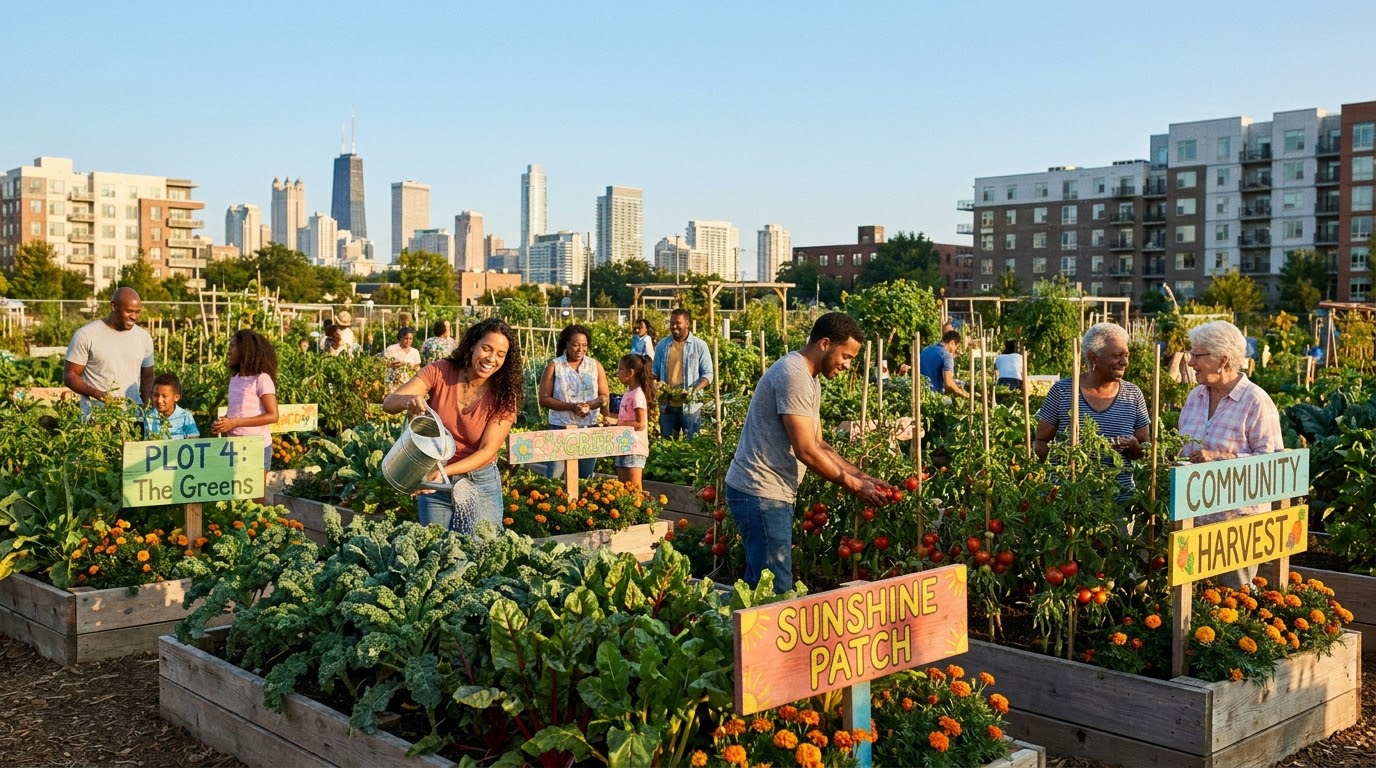
There is a vacant lot on the corner of Maple and Third that has been sitting empty for years. Weeds push through cracked asphalt, trash collects along the chain-link fence, and the neighborhood walks past it every day without a second glance. Now imagine that same lot transformed into rows of raised beds bursting with tomatoes, peppers, sunflowers, and herbs. Children run between the rows, elderly neighbors sit on benches sharing gardening advice, and the smell of fresh basil fills the air. That transformation, from neglected space to thriving community hub, is what a community garden makes possible.
Community gardens are shared spaces where people come together to grow food, flowers, and friendships. They exist in every type of neighborhood, from dense urban cores to suburban subdivisions to rural small towns. There are an estimated 29,000 community gardens in the United States, and that number grows every year as more people recognize the profound benefits these spaces provide: fresh food access, physical activity, mental health support, social connection, environmental education, neighborhood beautification, and community resilience.
Starting a community garden is a significant undertaking, but it is absolutely achievable with the right planning, team, and persistence. This guide walks you through every major step, from finding your first supporters and securing land to designing the layout, raising funds, establishing rules, and sustaining the garden for years to come. Whether you are a seasoned gardener or someone who has never planted a seed, if you have the passion and the willingness to organize, you can make a community garden happen in your neighborhood.
Why Community Gardens Matter
Community gardens deliver benefits that extend far beyond the food they produce. Research consistently shows that community gardens improve physical and mental health, strengthen social ties, reduce crime, increase property values, and enhance environmental quality in their neighborhoods.
Food security and nutrition: For families living in food deserts, areas with limited access to fresh, affordable produce, community gardens can be a lifeline. A single community garden plot can produce hundreds of pounds of fresh vegetables per season, supplementing family diets with nutritious food that might otherwise be inaccessible. Studies show that community gardeners eat more fruits and vegetables than non-gardeners and are more likely to try new foods and cook from scratch.
Physical and mental health: Gardening is moderate physical exercise that improves strength, flexibility, and cardiovascular health. It also reduces stress, anxiety, and depression. A study published in the Journal of Public Health found that community gardeners reported significantly lower levels of stress and higher levels of life satisfaction compared to non-gardeners. The combination of physical activity, time outdoors, social interaction, and the satisfaction of growing food creates a powerful wellness cocktail.
Social connection: In an age of increasing social isolation, community gardens create natural gathering places where people of all ages, backgrounds, and abilities come together around a shared purpose. Neighbors who might never interact in their daily lives develop relationships through the shared work of tending a garden. These connections build social capital, strengthen neighborhood identity, and create support networks that extend well beyond the garden fence.
Environmental benefits: Community gardens increase urban green space, reduce the heat island effect, absorb stormwater runoff, support pollinators and wildlife, and sequester carbon. They also reduce the carbon footprint associated with food transportation by producing food locally. Many community gardens incorporate composting programs that divert organic waste from landfills, further reducing environmental impact. Our guide to pollinator-friendly gardens explains how community gardens can support local ecosystems.
Finding Supporters and Building a Team
Every successful community garden starts with a small group of committed individuals who share the vision and are willing to put in the work to make it happen. You do not need a large group to begin. Three to five dedicated people who are willing to meet regularly, divide responsibilities, and persist through challenges is enough to get a community garden off the ground.
Start by talking to people in your immediate network: neighbors, friends, coworkers, fellow members of religious congregations, parents at your children's school, or members of civic organizations. Share your vision for a community garden and listen to their ideas and concerns. The most successful gardens are built on genuine community input, not one person's top-down plan.
Post flyers at local libraries, community centers, coffee shops, grocery stores, and laundromats. Use social media platforms and neighborhood apps like Nextdoor to spread the word. Contact your local parks and recreation department, cooperative extension service, or community development office to ask about existing community garden networks or resources. Many cities have organizations specifically dedicated to supporting community garden development.
Hold an initial meeting to gauge interest and gather ideas. Provide refreshments and create a welcoming atmosphere. Share information about the benefits of community gardens, present a preliminary vision for what the garden could look like, and invite input. Ask attendees what they would like to see in a garden, what concerns they have, and what skills and resources they can contribute. Leave the meeting with a list of interested volunteers and a plan for next steps.
Identify people with specific skills that will be valuable for the project. You will need people who can handle organizational tasks like writing bylaws and managing finances. People with construction skills will be invaluable for building raised beds and installing infrastructure. Gardeners with experience can help design planting plans and mentor newcomers. People with connections to local government, businesses, or media can help with land access, funding, and publicity. Our sustainable living guide has tips for connecting with like-minded community members.
Choosing and Securing a Site
Finding the right site is one of the most critical and sometimes challenging steps in starting a community garden. The ideal site has several key characteristics: adequate sunlight (at least six to eight hours of direct sun per day for most vegetables), access to water, relatively flat terrain, good drainage, and reasonable proximity to the community it will serve.
Sunlight is the most important factor because it cannot be easily remedied. A shady site under large trees or next to tall buildings will never produce the harvests that a sunny site can. Visit potential sites at different times of day to observe sun patterns. South-facing areas receive the most sun in the Northern Hemisphere and are generally the best choice.
Water access is the second most critical factor. Hauling water by hand is exhausting and unsustainable. The ideal site has a municipal water connection, a spigot, or access to a nearby building where a water line can be extended. If no existing water source is available, explore options for installing a meter and hydrant. Rainwater harvesting from nearby rooftops can supplement but rarely replace a reliable municipal water source.
Soil quality matters, but it can be improved over time. If the soil is contaminated with heavy metals, petroleum products, or other toxins, the site may not be suitable for food production without significant remediation. Soil testing is essential before committing to a site, especially in urban areas where past industrial use may have left residues. Our soil testing guide covers how to collect and interpret soil samples. If contamination is present, raised beds with imported soil offer a safe alternative.
Potential land sources include vacant lots (check with the owner or the city tax assessor), municipal parks and recreation land, school and church properties, housing authority land, land trust parcels, and private landowners willing to lease or donate space. Many cities have adopted policies that facilitate community garden access on public land, so contact your local government early in the process.
When approaching a landowner, whether public or private, come prepared with a clear proposal. Explain what a community garden is, describe the benefits to the neighborhood, present your organizational plan, address potential concerns (maintenance, liability, aesthetics), and propose a lease or license agreement. Offer to maintain the site better than its current condition and to restore it if the garden ever closes. A well-written proposal with letters of support from neighbors and local organizations carries significant weight.
Planning the Garden Layout
Once you have secured a site, the next step is designing the garden layout. A thoughtful design maximizes growing space, ensures accessibility, accommodates shared infrastructure, and creates an inviting atmosphere that draws people in.
Start by creating a simple map of the site, noting the boundaries, sun exposure, slopes, existing structures, trees, and access points. Designate areas for individual plots, communal growing areas, pathways, a tool shed or storage area, a composting station, a gathering area with seating, and possibly a children's garden or educational space.
Individual plots are the heart of most community gardens. Standard plot sizes range from 4 by 8 feet for raised beds to 10 by 20 feet for in-ground plots. Smaller plots are easier for beginners to manage and allow more gardeners to participate. Larger plots provide enough space for a family to grow a significant portion of their produce. Offer a variety of sizes if possible and let gardeners choose based on their experience and ambition.
Pathways should be at least three feet wide for comfortable access with a wheelbarrow, and four feet wide is better for ADA accessibility. Main pathways should be firm and level, surfaced with wood chips, gravel, or mowed grass. Avoid pathways that become muddy when wet, as this discourages participation and creates safety hazards.
Communal areas serve important social and practical functions. A shaded gathering area with benches or picnic tables encourages gardeners to linger, socialize, and share knowledge. A composting station teaches waste reduction and produces valuable soil amendment. A shared herb garden, pollinator border, or cutting flower area adds beauty and utility that benefits everyone.
Consider including a perimeter fence to define the space, deter vandalism, and keep out rabbits and dogs. A six-foot chain-link or welded-wire fence is effective and affordable. Gates should be lockable, with combination locks or key access for garden members. Security lighting can deter after-hours trespassing.
Raised Beds vs. In-Ground Gardens
One of the first design decisions you will face is whether to use raised beds, in-ground planting, or a combination of both. Each approach has distinct advantages and trade-offs.
Raised beds are the most popular choice for community gardens, and for good reason. They allow you to control the soil quality completely, which is especially important on sites with poor or contaminated soil. They warm up faster in spring, drain better in wet climates, and reduce weed pressure. They are easier to access for elderly or disabled gardeners and create a clean, organized appearance. The main disadvantages are the cost of construction materials and soil to fill them, and the fact that they dry out faster in hot weather, requiring more frequent watering.
Build raised beds from untreated lumber (cedar or redwood rot naturally), concrete blocks, galvanized steel, or recycled plastic lumber. Avoid treated lumber, railroad ties, and tires, which can leach chemicals into the soil. Standard dimensions are four feet wide (to allow reaching the center from either side), eight to twelve feet long, and twelve to eighteen inches deep. Fill beds with a mixture of topsoil, compost, and aged bark or coir. Our composting guide covers how to produce the compost you will need to fill beds and maintain soil fertility.
In-ground gardens are less expensive to establish because they do not require construction materials or imported soil. They retain moisture better and provide a larger volume of soil for deep-rooted crops. However, they require thorough soil testing before planting, may need significant amendment to improve native soil, and are more susceptible to weeds, compaction, and drainage issues. In-ground gardens work best on sites with good existing soil and where budget is a primary concern.
Many community gardens use a combination of both approaches, with raised beds for individual plots and in-ground areas for communal plantings like corn, squash, sunflowers, or cover crops. This hybrid approach balances cost, flexibility, and accessibility.
Establishing Water Access
Reliable water access is non-negotiable for a community garden. Without it, the garden will fail. The most common options for community garden water supply are municipal water connections with hose bibs, rainwater harvesting systems, and well water where available.
A municipal water connection is the most reliable option. Contact your local water department to inquire about installing a meter and spigot at the garden site. There will be installation costs and a monthly water bill, which should be factored into the garden's annual budget. Install multiple spigots distributed throughout the garden to minimize the length of hose runs and reduce wait times during peak watering hours.
Rainwater harvesting can supplement municipal water and reduce costs. Install gutters on any structures at the garden site and direct runoff into large rain barrels or cisterns. A one-inch rainfall on a 1,000-square-foot roof produces roughly 600 gallons of water, which can irrigate a significant portion of the garden. However, rainwater alone is rarely sufficient for an entire growing season, especially in areas with dry summers.
Drip irrigation is the most efficient watering method for community gardens. It delivers water directly to the root zone, reducing evaporation and waste. Drip systems can be connected to a timer for automated watering, which is especially valuable during vacations and busy periods. While the initial installation cost is higher than hand watering, drip irrigation saves water, reduces labor, and produces more consistent results. For more on water-efficient gardening, see our water and irrigation resources.
Tool Sharing and Storage
One of the great advantages of a community garden is the ability to share expensive tools that individual gardeners might not be able to afford on their own. A well-equipped community tool shed typically includes shovels, spades, hoes, rakes, garden forks, wheelbarrows, hand trowels, pruning shears, watering cans, hoses, and a lawn mower or string trimmer for maintaining pathways.
Secure storage is essential. A locked shed or storage cabinet protects tools from theft and weather damage. Position the tool storage area near the garden entrance for easy access. Install a hook-and-board tool organization system so tools have designated places and are easy to find and return. Create a sign-out system, either a clipboard log or a digital app, so tool usage can be tracked and accountability maintained.
Establish clear rules about tool care: return tools to their proper place after use, clean off soil, and report any damage or breakage. A small annual tool maintenance budget allows for sharpening, replacing worn handles, and buying new tools as needed. Some community gardens hold annual tool repair work days where members bring their personal tools for sharpening and maintenance as well.
Organizing Volunteers and Work Days
A community garden runs on volunteer energy, and organizing that energy effectively is one of the most important jobs of the garden leadership team. Without structure, enthusiasm fades, shared areas fall into disrepair, and the garden slowly declines. With good organization, the garden thrives and the workload is distributed fairly.
Schedule regular communal work days, ideally weekly during the growing season and monthly during the off-season. Work days tackle shared responsibilities like maintaining pathways, composting, weeding communal areas, repairing infrastructure, and seasonal tasks like spring bed preparation and fall cleanup. Provide clear task lists, assign team leaders for specific jobs, and ensure that tools and materials are ready in advance.
Create a system for tracking member participation. Many gardens require a minimum number of volunteer hours per season, typically eight to twenty hours, in addition to maintaining individual plots. This ensures that the shared workload does not fall on just a few dedicated individuals. Hours can be logged on a sign-in sheet at the garden or tracked through an online system.
Make work days social and enjoyable. Bring snacks and drinks. Play music. Celebrate accomplishments. Host potlucks at the end of major work sessions. The social dimension of community gardening is one of its greatest strengths, and events that blend work with socializing keep members engaged and coming back. Organize seasonal celebrations like a spring planting festival, a mid-summer harvest potluck, and a fall garlic planting party.
Creating Rules and Guidelines
Clear, well-communicated rules prevent misunderstandings, resolve conflicts, and ensure that the garden operates smoothly. Develop a written garden agreement that all members sign before receiving their plot. This document should cover plot maintenance expectations, allowed and prohibited practices, shared responsibilities, dispute resolution procedures, and policies for plot abandonment and reassignment.
Common rules include maintaining your plot free of weeds and pest infestations, not using chemical pesticides or herbicides (especially in gardens that share boundaries), keeping pathways clear of tools and personal items, watering responsibly and not wasting water, harvesting only from your own plot unless explicitly invited, respecting quiet hours (usually early morning and evening), and attending a minimum number of communal work days per season.
Address organic practices explicitly. Most community gardens require or strongly encourage organic methods. Define what this means in practical terms: no synthetic pesticides, no synthetic fertilizers, no genetically modified seeds. Provide resources and education for gardeners who are new to organic methods. Our guide to starting a vegetable garden covers organic growing basics that you can share with new members.
Establish a clear policy for abandoned plots. If a member stops maintaining their plot for a specified period, typically three to four weeks without communication, the garden leadership should contact them to offer help. If the situation does not improve, the plot should be reassigned to the next person on the waiting list. A clear abandonment policy prevents prime garden space from going to waste while being fair to members who may be temporarily unable to garden due to illness or other circumstances.
Create a conflict resolution process. Disputes between gardeners, while infrequent, are inevitable in any shared space. Designate one or two trusted individuals to serve as mediators. Encourage direct, respectful communication between parties first. If that does not resolve the issue, the mediators can facilitate a conversation. As a last resort, the garden steering committee can make a binding decision. The goal is always to resolve conflicts constructively and preserve the sense of community.
Funding Your Community Garden
Community gardens require ongoing funding for water, soil, compost, seeds, tools, infrastructure repairs, insurance, and occasional improvements. Establishing a sustainable funding model from the beginning prevents financial crises down the road.
Plot fees are the most common and straightforward funding source. Charge each member an annual fee for the use of their plot. Typical fees range from $20 to $100 per year, depending on plot size and local cost of living. Fee waivers or sliding-scale pricing can ensure that the garden is accessible to low-income families. Revenue from plot fees should cover basic operating expenses like water, compost, and tool replacement.
Grants can provide significant funding for startup costs and special projects. The American Community Gardening Association, local community foundations, corporate giving programs, and government agencies all offer grants for community garden development. The USDA Community Facilities Program, state agricultural extension services, and municipal community development block grants are additional sources. Prepare a clear proposal with a budget, timeline, community impact statement, and letters of support.
Donations from local businesses, nurseries, and individuals can provide materials, money, and expertise. Approach hardware stores for donated lumber and tools. Contact nurseries for surplus plants and seeds. Ask restaurants and grocery stores for compostable food scraps. Local contractors may donate soil, gravel, or mulch. Always acknowledge donors publicly and provide tax receipts when applicable.
Fundraising events build community while raising money. Plant sales, seed swaps, harvest festivals, farm-to-table dinners, garden tours, and workshops can all generate revenue while engaging the broader community. A spring plant sale featuring seedlings started by garden members is one of the most profitable and popular fundraising events for community gardens.
Community Garden Startup Checklist
The following checklist provides a phased timeline for taking your community garden from initial idea to first planting season. Adjust the timeline based on your local climate, available resources, and the complexity of the project.
| Phase | Task | Timeline |
|---|---|---|
| 1: Foundation | Gather initial group of 3-5 committed organizers | Months 1-2 |
| 1: Foundation | Hold community interest meeting | Month 2 |
| 1: Foundation | Research and contact potential land sources | Months 2-3 |
| 2: Land & Legal | Secure land through lease, license, or donation | Months 3-5 |
| 2: Land & Legal | Conduct soil testing for contamination | Month 4 |
| 2: Land & Legal | Establish legal structure (nonprofit or fiscal sponsor) | Months 4-5 |
| 2: Land & Legal | Obtain liability insurance | Month 5 |
| 3: Planning | Design garden layout and infrastructure plan | Months 5-6 |
| 3: Planning | Develop garden rules and membership agreement | Month 6 |
| 3: Planning | Create budget and funding plan | Month 6 |
| 4: Funding | Apply for grants and solicit donations | Months 6-8 |
| 4: Funding | Hold fundraising events | Months 7-8 |
| 5: Build | Clear and prepare the site | Month 8 |
| 5: Build | Build raised beds and install infrastructure | Months 8-9 |
| 5: Build | Install water system and fencing | Month 9 |
| 5: Build | Fill beds with soil and compost | Month 9 |
| 6: Launch | Assign plots to members | Month 10 |
| 6: Launch | Host orientation and opening day celebration | Month 10 |
| 6: Launch | Begin first growing season | Month 10+ |
Sustaining the Garden Long-Term
Starting a community garden is an achievement. Sustaining it over many years requires ongoing attention to leadership, finances, member engagement, and infrastructure maintenance. Gardens that thrive long-term share several common characteristics.
Rotate leadership. Burnout is the number one killer of community gardens. If the same one or two people carry all the responsibility year after year, they will eventually exhaust themselves and step away. Develop a leadership structure that distributes responsibilities among multiple people and rotates roles periodically. Create named positions like president, treasurer, plot coordinator, and work day organizer. Recruit new leaders from active members and mentor them into leadership roles.
Maintain finances carefully. Keep accurate financial records, hold annual budget meetings, and maintain a reserve fund for unexpected expenses. Transparency about finances builds trust and prevents conflicts. Post annual financial reports for all members to review.
Invest in infrastructure. Raised beds, fencing, sheds, and water systems all deteriorate over time and need maintenance or replacement. Set aside funds annually for infrastructure upkeep. A garden that looks neglected discourages participation and invites vandalism. A well-maintained garden attracts new members and earns community respect.
Keep the community engaged. Host regular social events, workshops, and celebrations. Invite speakers on topics like composting, pest management, cooking, and nutrition. Organize field trips to other gardens, farms, and botanical gardens. Create mentorship programs pairing experienced gardeners with newcomers. Welcome children and families with designated kids' areas and youth programming. The more people feel connected to the garden, the more they will invest in its success.
Document and celebrate. Take photos throughout the season. Keep records of what was grown, what worked, and what did not. Share successes on social media and in local media. Apply for community garden awards and recognition programs. Celebrate milestones like the garden's anniversary. These records and celebrations build institutional memory, attract new members, and remind everyone why the garden matters.
Starting a community garden is one of the most meaningful things you can do for your neighborhood. It transforms vacant land into a source of nourishment, beauty, and connection. It brings together people who might never have met and gives them a shared purpose. It teaches children where food comes from and gives seniors a reason to get outside. It makes your corner of the world a little greener, a little healthier, and a little more human. The work is real, but so are the rewards. Start with one conversation, one meeting, one raised bed. The rest will follow.
Frequently Asked Questions
How much land do I need for a community garden?
A community garden can start on as little as a quarter acre, which can accommodate 20 to 30 individual plots of about 10 by 10 feet each, plus pathways and common areas. Half an acre to one acre is ideal for a garden with 40 to 80 plots, shared tool storage, a gathering area, and possibly a composting station. Many successful community gardens are much smaller, particularly in urban areas where available land is limited. Even a few raised beds on a church or school property can serve as a starting point.
How do I find land for a community garden?
Start by looking at vacant lots, underused municipal land, church or school properties, land trust parcels, and private landowners willing to lease. Contact your city parks department, local government, or community development office to inquire about available public land. Many cities have programs that facilitate community garden land access. You can also post inquiries on community boards, social media, and neighborhood associations to find private landowners interested in lending or leasing space.
How much does it cost to start a community garden?
Startup costs vary widely depending on the size and scope of the project. A basic community garden with 20 raised beds, soil, tools, and a water source can be started for $2,000 to $5,000 if you rely heavily on volunteer labor and donated materials. A more elaborate garden with fencing, sheds, irrigation, and permanent infrastructure may cost $10,000 to $25,000 or more. Most gardens recover costs through annual plot fees of $20 to $100 per plot, supplemented by grants, donations, and fundraising events.
What rules should a community garden have?
Common rules include maintaining your plot free of weeds and pests, not using chemical pesticides or herbicides, keeping pathways clear, watering responsibly, harvesting only from your own plot unless invited, respecting quiet hours, and participating in communal work days. Rules about organic practices, allowed and prohibited plants, plot abandonment policies, and guest access should be clearly documented in a written garden agreement that all members sign before receiving their plot.
How do I get people involved in a community garden?
Start by talking to neighbors, friends, and coworkers who garden or want to learn. Post flyers at libraries, community centers, churches, and coffee shops. Use social media and neighborhood platforms like Nextdoor to spread the word. Host an informational meeting to share your vision and gather input. Reach out to local schools, senior centers, scout troops, and community organizations. Make the garden welcoming to beginners and experienced gardeners alike, and emphasize the social and health benefits beyond just growing food.
A community garden is more than a place to grow vegetables. It is a living expression of what happens when neighbors come together with a shared purpose. The tomatoes and peppers are wonderful, but the relationships, the knowledge shared, the children who learn where food comes from, and the neighborhood that becomes a little more connected are the true harvest. If your neighborhood does not have a community garden yet, it is waiting for someone like you to start one.